
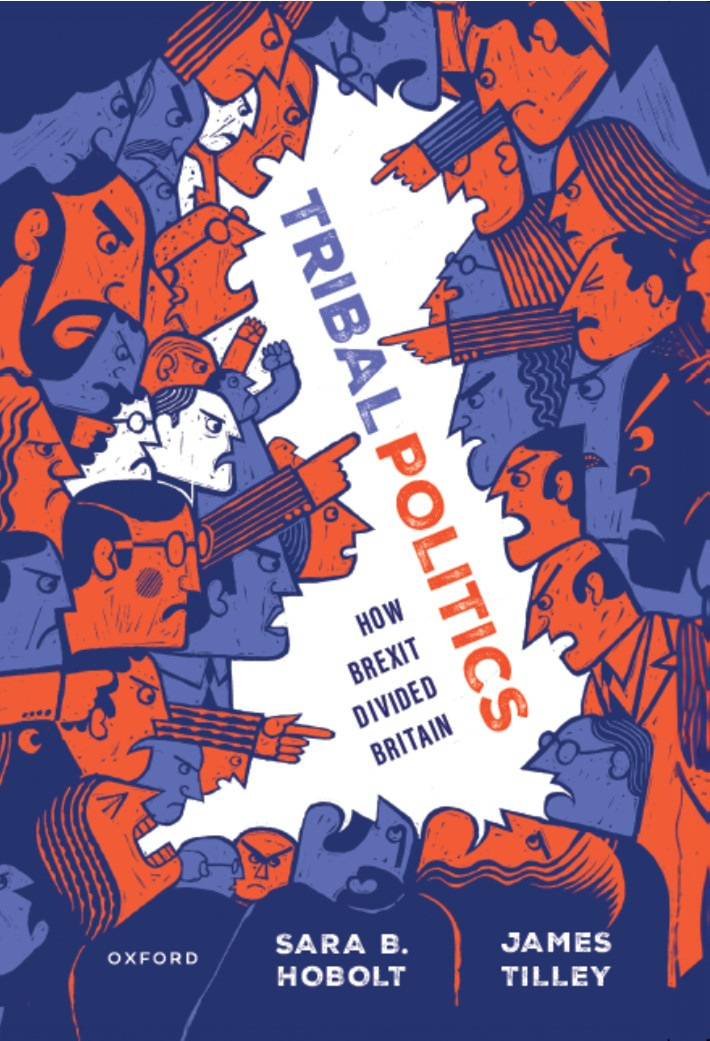
This is a guest post by James Tilley, a Professor of Politics at the University of Oxford, about his excellent new book with Sara Hobolt, Tribal Politics: How Brexit Divided Britain.

It is now almost ten years since the EU referendum. There will, no doubt, be an article in every newspaper next month detailing what Brexit has meant for the economy, national sovereignty, migration patterns, fishermen, farmers, and so on. But for me, by far the biggest change that the referendum brought about was the creation of two new political tribes: Remainers and Leavers.
Over the last decade, not only have more people in Britain claimed a Brexit identity than a party identity, but people’s emotional attachment to their Brexit tribe was, and is, substantially stronger than their party attachment. Membership of these new political teams, created over a few months, is more important to people than the party identities that dominated British society for the last century.
At first glance, this might seem strange. Before 2016, most of us had very little interest in the EU. When David Cameron said that he would call a referendum on membership in January 2013, only 2 per cent of people said that the EU was the most important issue facing the country. The referendum thus forced people to make a binary choice on an issue about which they did not have very strong feelings.
Before we vote on something, we can have ambiguous, changeable attitudes, but after voting, we resolve that ambiguity by choosing one side or the other and committing ourselves to a named group of fellow travellers. The fact that this tribal loyalty was then tested over years of wrangling over the actual outcome of Brexit (in 2018 and 2019, MPs said the word Brexit in their parliamentary speeches every five minutes on average) meant that people had the opportunity to rehearse and reinforce their new identity again and again.
Why are these new political tribes interesting? I think there are three reasons, and the first is that we got to see a rare event: new political identities being born. Before 2016 nobody thought of themselves as a Remainer or Leaver. Although characteristics like education, age and national identity were predictors of people’s attitudes to the EU issue, and ultimately their referendum vote, we absolutely cannot reduce the two sides to simple caricatures based on class, age, education, or even national identity.
As we show in the book, the vote was not simply an exercise in counting up existing groups who were pro-EU or anti-EU. Rather, many people who had similar middling views about the EU were forced by the referendum to make a choice in 2016 and plump for one tribe or the other. The decision people made on 23rd June then became a part of how they saw themselves and how they wanted others to perceive them.
Second, despite their overnight creation, these new political identities proved remarkably resilient and strongly held. By 2017, there was a small cottage industry in articles about how to avoid Christmas family rows about Brexit. Relationship counsellors, psychotherapists, and even hostage negotiators were asked by journalists how to defuse clashes between the Brexit tribes. Why was this seen to be necessary? Because new group identities meant new emotionally resonant in-group loyalties and out-group hostilities.
To better understand this, we use survey questions that focus on the degree to which people naturally identify with their group. For example, we asked people whether they usually said ‘we’ instead of ‘they’ when they talked about their own Brexit tribe. When the football team you support loses, you say ‘we played badly’, even though you never set foot on the pitch yourself. It is the same idea here.
Combining many measures like that, we find that Remainers and Leavers were consistently a lot more attached to their identity than were Conservative or Labour supporters. And those scores have been very stable over the last ten years. People like people like them. And they define ‘like them’ in terms of their Brexit tribe. All our measures also show that people not only disagree with, but really dislike, people on the other side and typically say that they have a ‘cold or unfavourable feeling’ towards their rival group. Again, this has barely changed since 2016.
Third, people engage in the same sort of motivated reasoning that we see for party identities. At the most basic level, any group identity that is strongly held will provide motivations to think that the other side is inferior and should be avoided. As our data shows, huge majorities say that their own Brexit group is intelligent, honest and selfless, while the other side is stupid, dishonest and selfish. In fact, when we asked people to describe the other side in their own words, a quarter simply listed bad things and another quarter did that in addition to other information (to give you a flavour, one of the pithiest responses was simply ‘selfish dicks’). However we measure it, we find widespread prejudice. And we also find lots of evidence of discrimination: people actively wanted to avoid everyday interactions with people on the rival team.
It is tempting to think of Americans as peculiarly politically divided, but the levels of hostility, prejudice and discrimination between the Brexit tribes are all as large as, or larger than, any partisan differences in the US. And if you have been reading this smugly thinking that this is just true of those foolish people on the other side, then think again, because almost all the consequences of tribalism that we reveal in the book are symmetrical: Remainers and Leavers are just two sides of the same coin.
For me, the aspect of motivated reasoning that is most interesting is how it shapes perceptions of the state of the world and remedies for its woes. For party identities, we normally think about politicians providing stories for people who identify with their party to tell each other. For the Brexit tribes, this is much less of an option, since there are no formal group leaders. And yet people were, and are, quite capable of independently searching for, and believing in, messages that support their own side’s view of reality, and then ignoring or rationalizing away information that contradicts that view.
Interestingly, sometimes that means not bothering to shop at the ‘marketplace of rationalizations’ at all. The difference between Leavers and Remainers over whether they thought that the outcome of Brexit on Britain would be positive or negative is enormous: nearly 3 points on a five-point scale. That has barely changed in ten years. Yet when we asked people, ‘what are those positive or negative effects?’, well over half of both Remainers and Leavers were unable to actually name anything specific. In short, if my side voted for the change, I say ‘good’; if my side voted against the change, I say ‘bad’.
This suggests that it may be the signalling aspect of motivated reasoning that dominates under these conditions. In other words, our Brexit identity influences our political opinions because we want to display the fashions of our group. But as there are no party leaders telling us what to believe, no fashion icons telling us what to wear, this process depends on knowing what other people in our tribe think. This limits our ability to change our policy opinions to match our tribe. On one issue we do have a very strong sense of what both sides think: Remainers love the idea of European integration and Leavers hate it. As we show, initial large differences in attitudes towards the EU became even larger after the referendum, as people sought to become good group members and adopt their group’s norms. But this also applied to some other policy areas, like immigration, about which people knew, or at least thought that they knew, the group norm.
There is a final key area in which we see both sides rationalizing away information that is inconvenient. It is always true that people who voted for the losing side are generally less happy with the democratic process than those who voted for the winner. This was particularly obvious for the Brexit tribes. Before the vote, many people thought that the Remain side would narrowly win. That proved incorrect, so the expected winners became losers and the expected losers became winners. In April, when Leavers thought they would lose, only a third said that the referendum would be ‘fairly conducted’. In December, after they had won, a big majority of the same people now said that it was fair. The exact opposite is true for Remainers. In April, a big majority said that it would be fair. In December, after they had lost, less than a quarter said that it had been fair.
Ten years on, most Remainers still think that the referendum was not ‘based on a fair democratic process’. Here, people are buying a rationalization that allows them to simultaneously feel that their group, and therefore they themselves, are superior (their side really won), signal to fellow Remainers that they are a good group member and cast doubt on the virtue of the other side. No wonder it is appealing.
If you live in Britain, you will know somebody who became a bit obsessed about Brexit: somebody who adorned their house with flags or posters; somebody who fell out with a friend because they voted differently; somebody who brought every topic of conversation round to Brexit and, depending on how they voted, saw every blessing or every curse as due to the referendum outcome.
What we hope we have done in our book is explain why this happened, and just as importantly, show systematically, using multiple surveys and experiments, that this process was real and lasting; that unimportant issue differences became hugely important issue identities; and that political tribalism is not always structured around venerable political parties, but can sometimes come from almost nowhere.
Very interesting. A general thought: do you think that the effects are especially strong because of the referendum? Would that be another reason to be opposed to direct democracy?
The UK struggles under the crushing weight of the Westminster accords, which focused on single member election ridings for the UK Parliament. So the UK has been dominated by two parties, both of which are adamant that no third party or change is possible. This domination of "other voices" has led to confusion, Brexit, and extremism by both major parties as other voices have no representation or participation in the UK Parliament. This archaic structure is mirrored in the US, with the abuse of gerrymandering compounding the problem. Meanwhile, in the US, more people register as unaffiliated, reflecting a distaste for the two major parties with their extremist policies and leaders. This problem is compounded in the US by the primary system in many states, that has low turnout, and two distasteful choices come November. Some other countries have addresses the unpopular two party system, by some hybrid arrangement involving some greater proportional representation of minor groups interests. There is a budding interest in open primaries, ranked choice voting, and some type of proportional representation system in the US. Generally, Democratic leaders oppose it and MAGA types denounce it. It's simply too much democracy!