

This is a guest post by Tibor Rutar: an assistant professor at the University of Maribor, an author of excellent books, and one of the very best—most interesting, insightful, data-driven, and objective—Substackers writing today on politics, society, and social science. I highly recommend that you subscribe to his newsletter, Political Economy, Stats, and Society.
Here are some statements that you might have heard at different times and in different venues concerning immigrants and crime in Europe:
Immigrants in many European countries are overrepresented in the prison population.
In Scandinavian countries, individual-level data show higher criminal offending in immigrant groups compared to natives.
There’s an inverse over-time correlation between immigration and homicide at the country level.
At the regional level, we tend not to see a relationship between immigrants and homicide.
Causally informative studies tend not to find clear evidence that immigrant influx causes crime to rise.
If we were going by political ideology, the first two might sound right-wing-coded, while the last three might sound left-wing-coded. In reality, all five are true. In this post, I want to document them in more detail and explain how it’s possible for all five to be true at the same time.
Claim #1: Immigrants in many European countries are overrepresented in the prison population.
If we limit ourselves to the developed OECD world (primarily for data-quality reasons and better comparability), you can see on the graph below that immigrants can be either over- or underrepresented in prison populations. In many European countries, like Switzerland, Germany, Greece, Austria, Slovenia, and Italy, immigrants are somewhat or even vastly overrepresented. In the English-speaking world, including the US, UK, Ireland, Australia, and New Zealand, the reverse is true.
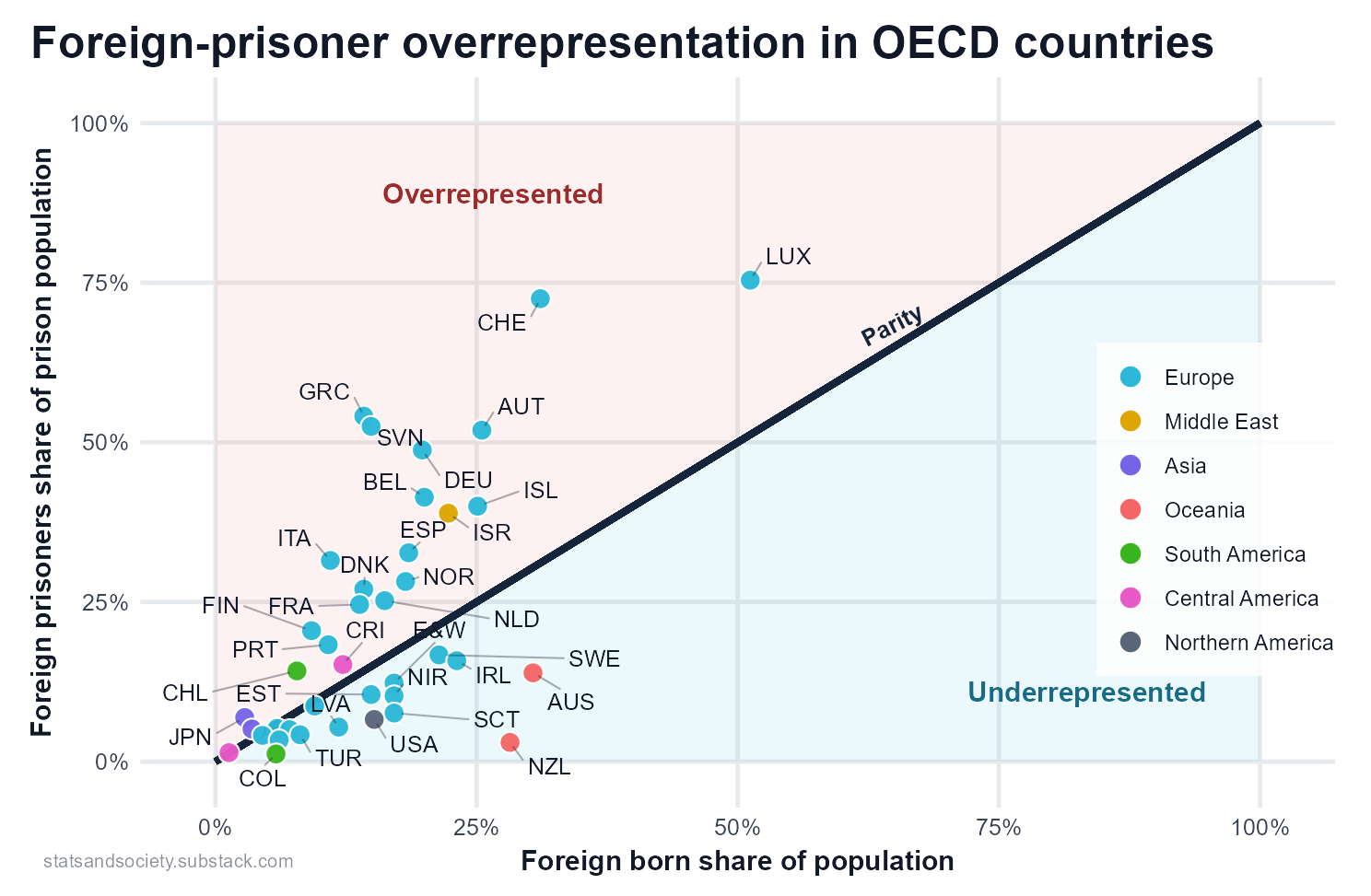
There are many reasons behind this difference.
For instance, some role has to be allowed for measurement issues, reporting proclivity/biases, and outright discrimination, but I’ll set these aside.
One absolutely key reason has to do with differences in the basic demographic makeup of various immigrant groups that choose, and are able, to enter different societies. In quite a few European societies, there’s a larger share of young, low-income, and low-educated males among those who come in. It is well known that this group of people, among natives and non-natives alike, has a much higher proclivity for criminal offending compared to older people with a better socio-economic status (and especially women).
Now, in normative debates over immigration, it is sometimes pointed out that such accounting is unfair. After all, if immigrant demographics in certain countries are reliably skewed toward traits associated with higher criminal offending, this is itself a problem. In other words, immigration critics say that it does us no good to explain away the representation gap with reference to age and sex. If immigrants are disproportionately young and male, and are thus disproportionally likely to offend or end up in prison, so much the worse for immigration, they’d say. “Keep them out!”
I don’t want to explicitly engage in normative reasoning in this piece, which is devoted to descriptively mapping out reality, but I’m not sure this retort is wholly successful. For one thing, many immigration skeptics don’t seem to worry so much over age and sex but rather over race/ethnicity/culture, net of age and sex. They seem to insist that “some people” (or people from “some cultures”) are just intrinsically more likely to offend, regardless of their demographics. Second, quite a few immigration skeptics would like to boost native fertility, thus increasing the young and male population in the process, even if that itself contributed to rising crime. And that’s fair enough. But then let’s not pretend the concern over immigration is just about demographics.
Claim #2: In Scandinavian countries, individual-level data show higher criminal offending in immigrant groups.
Where good data exist, we can see the same overrepresentation at a more granular, individual level.
Take Sweden, for example. Between 2015 and 2018, here’s how the rates of criminal suspects (any crime) differed. For Swedish-born (two Swedish-born parents), the rate was 3.2%. Among the foreign-born, it was 8.0%. The rate rose to 10.2% for those born in Sweden to two foreign-born parents.
So, compared to natives, relative risks were 2.5x for foreign-born and 3.2x for Swedish-born with two foreign-born parents.
Among foreign-born, the highest suspect proportions were among people born in West Asia, Central Asia, North Africa, East Africa, and other African countries. The lowest were among people born in East Asia, other Scandinavia, EU15/Western Europe, USA/Canada/Australia/NZ.
Or set aside suspects and take actual conviction rates in Denmark. The overall male population stood at 0.8% convicted in 2023. For male immigrants from the Middle East and North Africa, the share was 1.8%. Their male descendants were higher still, at 4.3%.
My previous point about demographics skewing the comparison also reappears here. In Sweden, after adjusting for age, sex, income, education, and municipality type, relative risks fall from 2.5x to 1.8x and from 3.2x to 1.7x, respectively. Note that even after demographic adjustments, rates can remain elevated compared to the native population. It’s not the case that demographic controls always completely erase the gaps. This indicates that, at least on the surface, there’s something to the idea that people from different cultural backgrounds have different propensities for crime. Note, however, that the differences (especially after demographic controls) are small.
But things get even more complicated. Though important and factual, Claims #1 and #2 are not by themselves definitive if we’re interested in whether (and by how much) immigrants overall boost aggregate crime in societies. In fact, these are separable issues. This is so because, as Sarnecki et al. (2025) observe:
[U]nderstanding individual criminal behavior differs greatly from understanding rates of crime. Crime rates are typically measured through recorded crime, which does not necessitate identification of an individual associated with the crime. In fact, the majority of reported crimes are never connected to a suspect or perpetrator. …
Using data on individuals processed through the criminal justice system and average risks of offending may lead to inaccurate conclusions on the association between immigration and crime.
Actual offending, which shows up in aggregate crime stats even when perpetrators are at large, and processed offending, which is represented by arrests and imprisonment, are not the same thing. One cannot necessarily move from the latter to the former.
Second, criminals make up a tiny minority of people in any large population, be it native or immigrant, culturally European or non-European. Hence, even when some groups do contain higher absolute, individual numbers of criminals (which is of course important to know), the share of criminals within that group is very likely to still be small, overall. That means that any aggregate impact at the population level will also be small. Now, it would be wrong to claim that because aggregate causal impacts of immigrant influx might be small or non-existent, this means that there are no differences between the groups, or that criminal proclivity is the same in the native and non-native population. But, again, the point is precisely that these are not the same questions and so they shouldn’t be conflated, as they often are.
Claim #3: There’s an inverse over-time correlation between immigrants and homicide at the country level.
You’ve probably seen the meme below making the rounds on social media.

The idea is that rising immigration obviously drives rising violent crime when you look at a simple correlation between the two variables. Now, this is wrong for at least two general reasons.
First, you can’t simply correlate two variables and discern causal links from that. Almost always, there exist myriad unobserved confounders, which make virtually any simple bivariate correlation spurious.
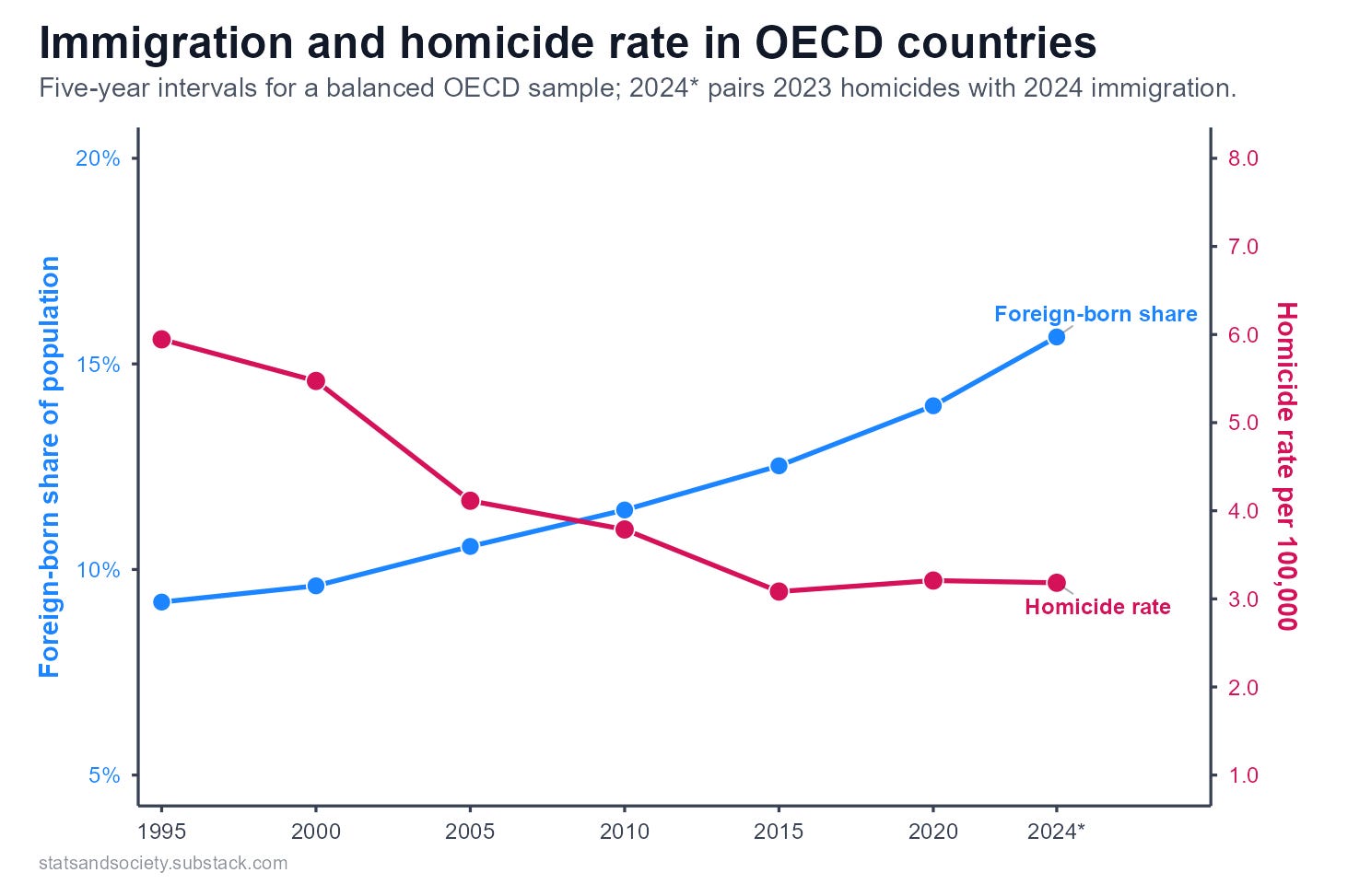
Second, the positive correlation between immigration and crime in the meme is made up. It’s a cartoon, after all. If you look at real data for the developed world (below), you see no positive correlation. In fact, there’s a clear negative correlation. As immigration goes up, homicides go down. Again, this is basically useless because of unobserved confounding (or because comparing stocks and flows might not be what you want to look at). But it’s funny to see reality be the literal opposite of what the meme portrays it as. And can you imagine if the meme was correct? If the correlation between immigration and homicide was positive? We’d never hear the end of it from immigration skeptics, even though the same point about confounding and irrelevance would apply.
Claim #4: At the regional level, we tend not to see a relationship between immigrants and homicide.
Aside from confounding, national-level relationships (or lack thereof) might not be as informative because they’re just not very fine-grained. So what do we see at the regional level?
This is an especially important question, because as Sarnecki et al. (2025) put it:
This meso level of analysis, unlike the individual level, allows for analysis of all reported crime regardless of whether a suspect has been identified. By analyzing all reported crimes, we can mitigate potential bias related to the over-representation of immigrants in individual crime data, which may arise from factors such as policing practices or private individuals’ greater likelihood to report crimes when they believe the suspect is an immigrant. Additionally, focusing on the meso level, as opposed to the national level, allows for analysis of smaller area-level patterns that may be obscured at the national level
Marie and Pinotti (2024) looked at dozens and dozens of regions from 10 European countries between 2002 and 2017. Regardless of how they analyzed the data and whether they looked at homicides or vehicle theft, there’s no relationship between changes in migration rates and changes in crime rates. No matter which statistical estimator they used – ordinary least squares (OLS), OLS with fixed effects, or shift-share instrumental variable regression – nothing shows up.
Sarnecki et al. (2025) turned specifically to Swedish municipalities between 2000 and 2020. They found that Swedish municipalities generally saw violent crime rise from 2000 to 2020, but that rise did not track with the share of residents born abroad. The municipalities with the steepest crime increases did not have unusually high immigrant population shares; in fact, their immigrant shares were similar to, or sometimes lower than, municipalities where crime stayed relatively stable.
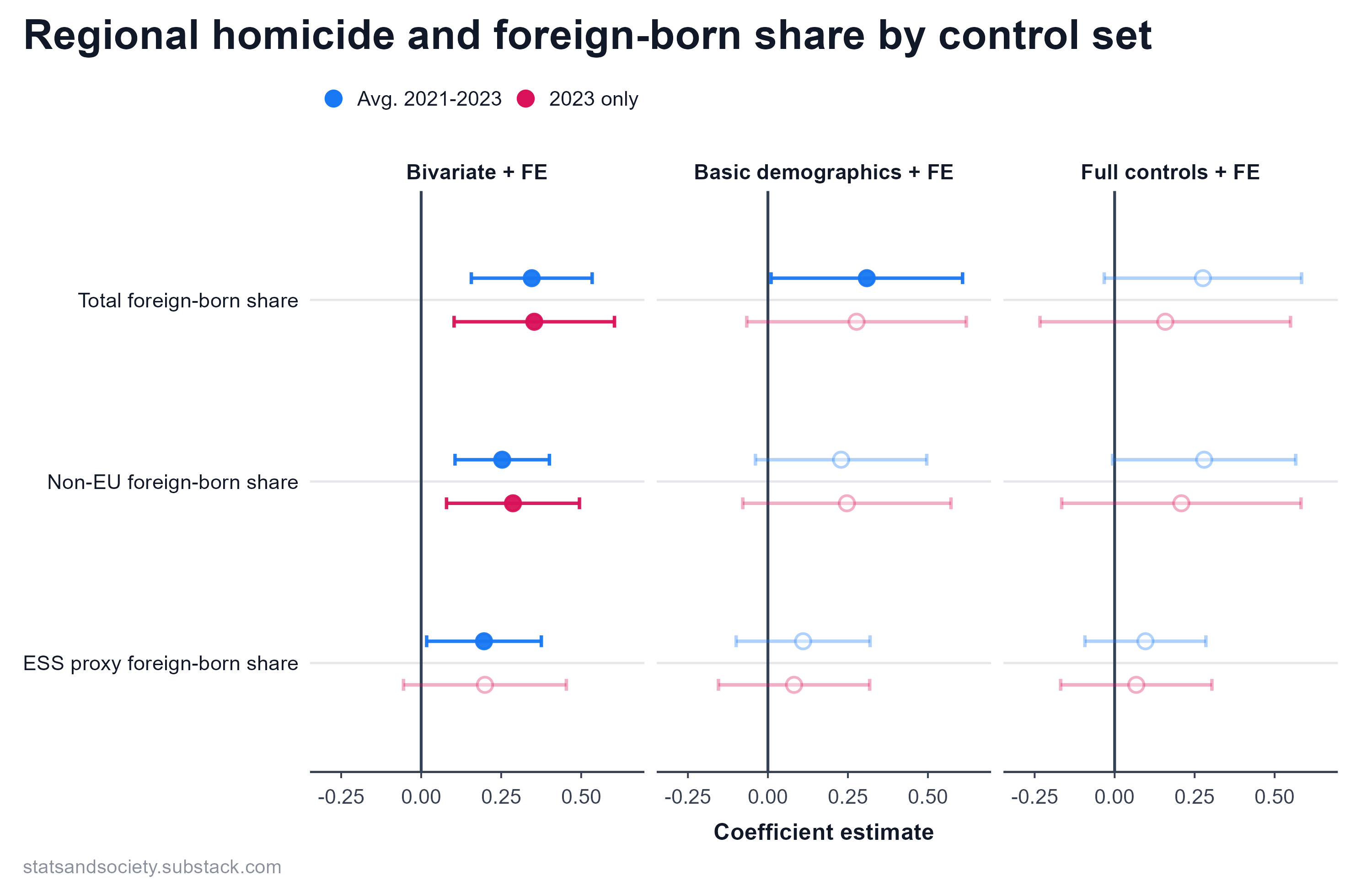
I find something similar in a simpler, cross-sectional test with 80 regions (using recent ESS data). I use both administrative and survey-based data on foreign-born shares for different regions, and I’m able to distinguish between total foreign-born shares and non-EU foreigners. Without any controls, there’s weak evidence that regions with more immigrants have higher homicide rates, though that’s not wholly consistent across measures. With basic demographic controls in place, statistical significance vanishes.
Claim #5: Causally informative studies tend not to find clear evidence that immigrant influx causes crime to rise.
Individual studies and broad reviews typically summarize the existing literature on the topic as follows:1
Research from around the world has generally indicated that immigration has little to no effect on aggregate rates of crime.
- Sarnecki et al. (2025)
Overall, the evidence from shift-share instrumental variable estimates in the United States and in European countries suggests no significant effect of immigration on property or violent crimes.
- Marie and Pinotti (2024)
A recent paper studying the causal effects of immigration on crime in Germany finds no link in the post-2015 period, although there seems to have been a positive (normatively deleterious) effect at an earlier time. A different study focusing specifically on refugees in Germany concluded that though refugees do not appear to boost crime rates in the short term, one has to look at lagged effects, where the link does show up. In his book Does Immigration Increase Crime?, Pinotti looks at EU-wide data on refugee influxes over two decades, and “fail[s] to find a significant impact on any of the eight categories of criminal offences we consider (burglary, robbery, vehicle theft, drug, assault, homicide, rape, and sexual assault).”
It’s hard to say with any high degree of confidence what’s going on in individual countries. But overall, the accumulated evidence does not support those who insist that immigration in Europe clearly and strongly boosts crime rates; at least not in the sense that would be detectable at regional and national levels. Of course, that’s not to say there’s definitely no effect. Moreover, disaggregating among different groups of migrants might point in different directions, as indicated by data on prison population overrepresentation and individual-level offending/suspect data.
In How Migration Really Works, Hein de Haas rightly claims that, broadly speaking, “evidence from Europe is more scattered, but what is available equally challenges the idea that immigration increases violent crime.” However, he then cites a 2020 paper titled “I May Be an Immigrant, but I Am Not a Criminal” as support, which is actually a pretty mediocre correlational study. We have better (if imperfect) data and designs that challenge the idea that immigrant influxes clearly and strongly increase crime, but we should also admit we don’t really know either way with any high degree of certainty.
What we do know is that there are many levels of analysis at which we can look at an issue like immigration and crime. And as I’ve hopefully shown, the nuances that emerge from such a multi-pronged approach cannot be squared with any simple-minded culture-war position on the matter.
Sometimes you get a more mixed picture:
Overall, the existing literature on the US and selected European countries is not conclusive regarding the effect of immigration on crime. - Nunziata (2015)

Thanks, Tibor (and Dan), this is great as usual! My experience is that even among immigration professors, very few people are willing to acknowledge the veracity of all these true points.
But I'm a bit disappointed in you not having any sort of conclusion here. Especially for the broader public, my experience is that leaving things at "it's complicated" is never a good idea.
As I've written before (https://www.popularbydesign.org/p/immigration-is-not-a-thing-that-has), there's plenty of evidence strongly suggesting that some types of immigration (young, male, low-educated, arriving under asylum or illegal entry) are involved in crime, so you can't just brush it aside. The question people are usually interested in is not whether an exogenous increase in immigration in general raises crime in a particular area, but whether admitting a certain number of young asylum seekers from a particular region will make their country safer or not. That's a different thing altogether. So I do want to push you a bit on having the courage to say what you think we should actually do about any of this :)
P.S. Also, I see a potential Lauren Gilbert erasure: https://www.laurenpolicy.com/p/immigration-and-crime-in-europe
I'm going to comment on the area I know something about: Swedish crime stats.
Firstly, the number of foreign borns in Swedish prisons is unknown, because they don't want to do statistics on it. One estimate is that 70-80% of the prison population has "foreign background". (foreign born or with both parents being foreign born)
The number 24% is how many prisoners that have foreign citizenship.
Secondly, the crime rates for some groups is a lot higher than x3. Here is a screenshot from a report by the Crime Prevention Agency. https://postimg.cc/G9CbWPPX It is not translated but I can explain that men, age 15 and above, born in North Africa, 24% were suspected of a crime. In second generation it is 30%.
East Africa and Other Africa have almost identical numbers.
This can't just be explained away by saying that suspicion is not the same as convictions, age, socioeconomy, racism or what not. There are clear and indisputable differences, and the rate for those nations is x10 that of those with native background.
30% suspected of crime is not a tiny minority, it's a significant amount.
As for Jerzy Sarnecki, he has since the 1980s done research with the purpose of proving that immigration cannot possibly increase crime, in such a stubborn way that he has become a meme.
The flaw in adjusting for income, education and socioeconomy is that criminal people tend to be poor and uneducated. They tend to live in poor areas and surround themselves with similar individuals. If we adjust for poverty, we could claim that no one has any overrepresention. We could bring in a million illiterates and have soaring crime rates, and yet claim that "adjusted for education, crime rates have not increased".