

Today is the official publication date of The Social Roots of Delusions, a book that I co-authored with Sam Wilkinson and Kengo Miyazono.
Unless you’re a member of the billionaire class, you probably can’t afford to buy it at the price Oxford University Press have set (although this discount code might help a little: AUFLY30). However, some of you will be able to access it online or ask your university or local library to order it. And even if you can’t do any of these things, you still might be interested in hearing about its main ideas and arguments.
So, this post provides a summary, which is hopefully at least somewhat accessible. Although the book itself is very much an academic one, it is also highly interdisciplinary and written to be accessible to researchers across a wide range of fields, including philosophy, evolution, anthropology, psychology, neuroscience, psychiatry, and social science.
What the Book Argues
When people hear the title, they often assume it is a book focused solely on clinical delusions of the sort associated with conditions such as schizophrenia, bipolar disorder, dementia, and so on. An individual diagnosed as holding delusions in this sense might believe that their spouse has been replaced with an imposter, that they are the reincarnation of Napoleon, or that their neighbours are spying on them through their television.
A classic question in the psychological and medical sciences is where these strange beliefs come from. How can individuals become convinced of such ideas? And why would they hold onto them even when they are presented with so much apparent counter-evidence?
Although our book addresses these questions, they are only part of its concern.
It is also focused on collective delusions—what Charles Mackay famously called “extraordinary popular delusions and the madness of crowds”. Think, for example, of witch hunts, the Satanic panic, bizarre conspiracy theories like QAnon, or the strange supernatural myths of sects and cults.
Those swept up in these belief systems needn’t be mentally ill, and yet the beliefs often seem just as irrational as anything one might encounter in a clinic. What drives such outbreaks of collective madness? Why do communities of healthy, seemingly rational humans so often “lose their minds”?
This question invites a deeper conceptual puzzle: What does it even mean to classify a belief or person as delusional? Today, many psychiatrists and philosophers insist that the only real delusions are clinical ones. Are they right? Or might there be an underlying logic that explains why ordinary people are drawn to similar terms and ideas—mad, crazy, insane, delusional—whether the strange belief belongs to an individual or a collective?
Given the title, you can probably guess that our answers to these questions have something to do with human sociality. To understand delusions—why they emerge, what forms they take, and what the concept of delusion is even for—we must start not from a focus on what goes wrong inside individual brains but from the fact that we are a deeply social species.
Of course, merely saying “humans are social” is a platitude. The aim of our book, then, is to clarify the nature of this sociality and explain why it matters here, which we do by integrating a large body of research from evolutionary theory, anthropology, cultural evolution, psychology, social science, and epistemology.
Homo sapiens, we argue, is an ultra-social creature utterly dependent on complex systems of cooperation and culture to know and navigate our world. This dependence warps our psychology at almost every level and provides the background arena for our enduring conflicts and competitions.
This picture informs our account not just of delusion but also of human knowledge. Outside of narrow domains, knowledge of our reality is not the default state of human minds, even when they are healthy or functioning well. It is, instead, a fragile achievement of complex epistemic cooperation—of a vast collaborative enterprise of creating, communicating, and evaluating information—that rests on precarious networks of trust, testimony, reputation, and a division of intellectual labour.
This social-epistemic machinery, we argue, is our species’ epistemic superpower, but it is also the source of our vulnerability to becoming delusional.
Keynes vs Nietzsche
We illustrate this dual character of human sociality with two quotes:
The first comes from John Maynard Keynes:
“It is astonishing what foolish things one can temporarily believe if one thinks too long alone.”
The second comes from Friedrich Nietzsche:
“Madness is something rare in individuals—but in groups, parties, peoples, and ages, it is the rule.”
Keynes’ quote draws attention to our epistemic dependence on others, which manifests in at least two ways. On our own, we can discover and understand very little of the world. Outside of the narrow domain of our first-hand experience, we rely entirely on others to learn about reality. This, of course, is a central lesson of research on social epistemology and cultural evolution.
Less obviously but just as importantly, solitary reasoning is treacherous. Although we have powerful capacities for reasoning, Hugo Mercier and Dan Sperber have documented what typically happens when we reason alone: freed from pushback and correction from others, we typically just manufacture additional confirmations and rationalisations of what we already believe.
However, this deep reliance on others also makes us highly vulnerable to deception and manipulation. To navigate this dependence, we have evolved capacities of “epistemic vigilance” through which we evaluate the plausibility of what we are told, the trustworthiness of testifiers, and the quality of their arguments. The problem is that this whole arrangement is fragile: if it breaks down—for example, through isolation, mistrust, and social disconnection—bizarre or “foolish” beliefs can come easily.
This lies at the core of our story about clinical delusions. We emphatically do not deny that things often go “wrong” inside the brains of delusional individuals in such cases: for example, perceptual abnormalities, or disturbances in how prediction errors are processed. But we argue that these disturbances become catastrophic precisely when a person becomes cut off from the corrective testimony and feedback of others, at which point solitary reasoning and sense-making start elaborating and rationalising the resulting beliefs.
Next, turn to Nietzsche’s quote, which highlights the other face of human sociality. Although the machinery of epistemic cooperation lies behind our capacity to know and navigate the world, and fuels our most spectacular epistemic achievements, it also enables perfectly rational, healthy individuals to co-create spectacular forms of madness and irrationality. Our book also aims to tell that story.
The Book’s Three Parts
The book develops these ideas across three parts.
Part 1 first develops the core scientific framework underlying everything else in the book: a picture of human beings as deeply cooperative, cultural, and competitive apes. We can’t survive or succeed alone; we acquire most of what we know from others; and we’re locked in conflicts of interest and competition for status, which makes us crave social approval and esteem and leaves us highly vigilant for deception and manipulation. I’m proud of this framework: if you want a clear, scientifically informed account of our evolved human nature and sociality, I think it is a good place to start.
The book then draws on this framework to understand the concept of delusion. Traditional accounts of the concept often look for neat psychiatric or epistemic criteria to tell us what delusions really are. Against this, we argue that treating someone as delusional (even when people don’t use that specific word) is less a diagnosis than an expression of bafflement at the relevant beliefs and a signal to others that the person in question is a “rational lost cause”—someone unreachable, on the relevant topic, by rational argument and persuasion.
Of course, once rational persuasion is off the table, we might be drawn to non-rational attempts to change the person’s mind, which is the approach adopted in modern medical psychiatry. However, illness or pathology is not essential to the concept in our view. We can and do express the same bafflement, and recommend the same kind of rational disengagement, when confronted with strange non-pathological beliefs—most obviously, in the collective delusions already mentioned. And in other times and cultures, people have sought spiritual interventions (e.g., demonic exorcism) for such beliefs, not medical ones.
Part 2 asks where collective delusions come from. Against theories that attempt to answer this question by looking at in-the-head cognitive biases, wishful thinking, or simple social learning biases, we argue that the most striking examples of collective delusions must be understood in terms of the strategic, social goals they serve. This includes goals such as advocacy or “propaganda” (e.g., witchcraft accusations and bizarre conspiracy theories that demonise target victims in ways that justify their exploitation) and social signalling (e.g., doctrines of cults and sects that signal group membership and allegiance).
Importantly, none of this requires conscious dishonesty. Sincerity and strategy, we argue, are not opposites: people often internalise those beliefs that help them persuade others, support allies, demonise enemies, or display their social allegiances.
When these motives are distributed across whole communities, they invert the machinery of epistemic cooperation, redirecting it away from the goals of learning and inquiry to the task of promoting and protecting shared fictions. People co-create “epistemic reward systems”—systems of social incentives, status competition, and a division of intellectual labour—that support forms of collective irrationality no individual could achieve alone.
Part 3 then turns to the clinic. As noted, our framework for understanding these beliefs does not deny that individual disturbances or psychological malfunctions often play a significant role. For example, they typically generate strange perceptual and affective experiences that people struggle to explain, and they can distort how the brain processes information.
Nevertheless, we argue that an exclusive focus on what goes wrong inside individual brains overlooks three of these beliefs’ most striking social features:
social adversity—abuse, discrimination, marginalisation, humiliation—significantly increases people’s risk of developing them;
they focus overwhelmingly on social themes such as surveillance, conspiracy, control, and status;
they are peculiarly resistant to social evidence—to the testimony of family, friends, and doctors.
This latter characteristic is especially surprising in a species so reliant on social learning. If strange experiences lie at the root of clinical delusions, why do delusional individuals prioritise the misleading evidence of those experiences over the consistent corrections they receive from seemingly trustworthy people?
We address this and other puzzles by appealing to the complexities and vulnerabilities of human ultra-sociality.
For example, the social world we must navigate is uniquely complex, opaque, adversarial, and high-stakes. Unlike physical objects, rational agents can conceal their intentions, coordinate with others in secret, manipulate our evidence, and execute long-term strategies. Hence, not only do our minds instinctively gravitate towards social explanations of unusual events, but these explanations are uniquely challenging to disconfirm. What would disprove the worry that you’re the victim of a carefully concealed long-term plot?
We also explore the many reasons why people suffering from psychological distress, disturbances, and social exclusion can become cut off from the corrective social feedback on which we normally depend to regulate our beliefs. In such cases, the epistemic vigilance that ordinarily protects us from manipulation and deception ends up protecting beliefs from disconfirmation, and the biased, lawyerly character of reasoning that usually helps us persuade gets to work in elaborating and rationalising those beliefs.
The Blind Leading the Blind
This is a brutally compressed summary of a 120,000-word book, but hopefully it gives a fair overview of what the book is about.
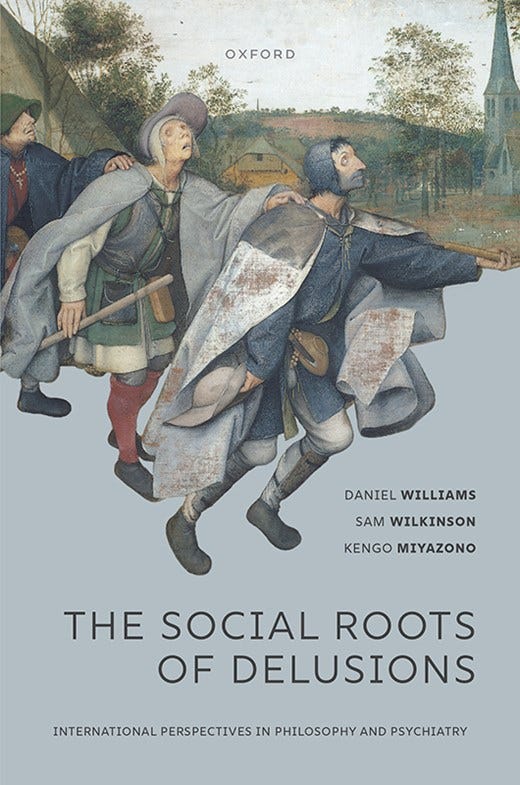
It also helps explain the book’s cover: Bruegel’s The Blind Leading the Blind.

For us, the painting is not a metaphor for mental illness. It captures a deep truth about the human condition. On our own, there is an important sense in which none of us can see. To learn about the world, we must rely on others, who are in precisely the same situation.
The painting also highlights a fundamental explanatory inversion at the heart of our project.
The puzzle of delusions is sometimes framed as asking why people “lose contact with reality”. For us, however, seeing things clearly—being “in contact” with reality—isn’t the default state of human minds. It’s a complex, fragile, and highly fallible achievement.
The fundamental puzzle, then, is not why some people believe false things, but how any of us, some of the time, manage not to.
We hope that this inversion both demystifies and destigmatises delusions.
Find the book here
Gosh, this is fantastic. Thank you for sharing. It seems to me that online communities are significant drivers of a higher percentage of people believing delusions, compared to, say, 1990 (but maybe not compared to when we lived in smaller communities?).
I particularly like how succinct these lines are in covering so much important info:
"Outside of narrow domains, knowledge of our reality is not the default state of human minds, even when they are healthy or functioning well.
"...enables perfectly rational, healthy individuals to co-create spectacular forms of madness and irrationality"
Oh wow. Yes that is quite pricey - I can't promise I'll be shelling out for that.
I must say I'm always a bit sceptical about philosophical theories of delusions. I remember hearing someone like Martin Davies talking about how patients don't act on their delusions and being struck by how little his description reflected the patients I actually saw where they certainly did act on their delusions in various rather serious ways.
Personally I tend towards a salience description of delusions - there's a balance of internal and external salience and a lot of what I might call "overvalued ideas" like AI psychosis, conspiracy theories etc seems to depend on external reinforcement and/or lack of friction against such ideas. But in the true delusional experiences I see esp delusional perceptions, nihilistic delusions, and thought alienation and passivity phenomena I'm a lot more sceptical of any kind of social explanation. Sure delusional content is often related to what is going on in the world around the patient - I don't see so many fears about the IRA but a lot more about being called a paedophile now. But these really do seem to be driven by internal rather than external features.
You really have to debate with someone who is psychotic (e.g. trying to persuade someone to eat who is fasting for months because God has told them they can exist on air) to understand just how outside of normal discourse and argument they are. To have a doctoral student explain to you that they understand how what they are saying sounds incredible *but it is really happening to them*!
So I'm a little intrigued how you thread the needle of delusions being both social generated and the sufferer being socially disconnected through epistemic vigilance.