

A common complaint levelled against capitalism concerns its reliance on the “profit motive”. The assumption is that it would be better to organise our economies around cooperation, mutual aid, or other elevated ideals, not the pursuit of personal gain. “People, not profit”, as the slogan goes.
Some versions of this complaint rest on simple technical mistakes or economic illiteracy. For example, profit is an important signal that a firm is using a society’s resources efficiently, which is why even many socialists who reject central planning want to keep profit-maximisation as an objective of firms. They want to change who owns firms, not what firms aim at.
Similarly, many blame the profit motive for problems caused by the bad rules under which profit-seeking operates. AOC complains that capitalism, at its core, “is the absolute pursuit of profit at all human, environmental, and social cost”, but no actual capitalist economy works this way. Societies create rules within which profit-seeking takes place. Many critiques of the profit motive point at outcomes that could be fixed by changing these rules, such as through taxes that make companies internalise the social or environmental costs of their products.
Economists and philosophers have been pointing out mistakes like these for generations, usually with little effect. This is because opposition to the profit motive gets its energy not from sober economic analysis but from a basic moral complaint.
Capitalism, the complaint goes, is powered by self-interest, greed, and personal ambition. These motives are bad. We teach our children not to be acquisitive and competitive, and we disapprove of people who exhibit these traits in everyday life. So, why would we organise our economies around them, or be surprised when those economies feature crisis, exploitation, or environmental catastrophe?
It’s easy to sympathise with this analysis, but it rests on significant confusions about some basic facts of human social life and the central challenges of politics.
In an important sense, the pursuit of profit is not an optional feature of societies. It is a fixed constraint on all societies that, at most, can be channelled and redirected, never abolished. More precisely, you can outlaw profit-seeking companies, but you can never abolish the pursuit of personal advantage and social standing. Attempts to do so often either push this pursuit in more destructive directions or conceal its operation in dangerous ways.
Profit in Other Currencies
Consider, first, those anti-capitalist groups that define themselves by opposition to the profit motive. I’ve spent some time around such people in my life and used to be very left-wing myself. One thing that is obvious about them, even if it is not obvious to them, is that these groups are not exactly free from the forces of self-interest, status squabbling, power plays, or personal ambition. Instead, they typically compete in a different currency: a reputation for true virtue, which, in practice, means a reputation for being more authentically left-wing than others.
This competition leads to the familiar (and funny) tendency of far-left groups claiming ideals of cooperation and equality to constantly split into warring factions locked in vicious, petty power struggles. Monty Python’s Life of Brian famously parodied this process: the People’s Front of Judea, the Judean People’s Front, the Judean Popular People’s Front, and the Popular Front (just one guy) all hate the Romans but hate each other far more.
And yet the process continues. Last year, Jeremy Corbyn and Zarah Sultana launched the far-left, anti-capitalist “Your Party” in the UK. Within months, it had split into rival factions. A party opposed to the profit motive (Sultana thinks we should “nationalise the entire economy”) and committed to organising society around solidarity couldn’t muster the minimal solidarity needed to hold itself together.
The more mainstream Great Awokening has featured a similar marriage of symbolic egalitarianism and ferocious status competition. Calls for social justice have often been championed loudest by people with Steve Jobs levels of personal ambition. Cancel culture campaigns have channelled powerful emotions of dominance, rivalry, and resentment. Woker-than-thou arms races have driven an ever-expanding set of moral concerns. And many have sought to accumulate what Musa al-Gharbi calls “totemic capital”, the social authority individuals could win from claiming membership of designated victim groups.
These observations aren’t enough to discredit such movements. For one thing, virtue signalling and moral competition for esteem are universal. Even God is irritated by “holier than thou” attitudes in the Book of Isaiah, where the phrase comes from. (So-called “vice signalling” on the modern right only seems vicious to centrists, liberals, and leftists; on the right, it signals the virtue of attacking mainstream liberal values.)
For another, the motives of people within a community say little about whether its convictions are correct. Perhaps it is a good thing that so many highly educated professionals compete to display culturally progressive values.
The lesson is deeper: self-interest and competition, especially over status, never really disappear from human social life. They are conserved. (Elsewhere, I’ve called this an approximate conservation law of social life, adapting a term from Bourdieu.) Take one currency of competition away, and people will compete in another.
The fact that these motives have always emerged among those left-wing political movements most vehemently and conspicuously opposed to them provides some evidence for the law. Famously, every communist regime that has succeeded in abolishing private profit has simply replaced it with intense competition over political power and favour within brutal, cut-throat hierarchies. (Will Storr tells this story exceptionally well in The Status Game.) Similarly, as Joseph Heath and Andrew Potter have documented, the Western “counterculture” movement that emerged in the second half of the twentieth century and sought to rebel against consumer capitalism merely created its own evolving systems of distinction, social rank, and market demand, with each successive wave convinced that previous ones had “sold out”.
Just as banning the economic profit motive merely channels profit-seeking elsewhere, abandoning some forms of conspicuous consumption merely shifts ambition towards new ways of advertising social standing.
In 2026, these facts shouldn’t really be surprising. Contrary to a surprisingly persistent amount of copium among the modern intelligentsia, Darwin really was right: we are apes that evolved through a process of natural selection. And although the point must be handled carefully, natural selection really is a competitive process, and it gives a very simple reason to expect that apes such as us would evolve to care about our individual interests, genetic relatives, and social standing.
It also gives a simple reason to doubt that money, as such, is a fundamental source of human motivation. Our deepest drives, in contrast, are focused on the kinds of things that correlated with reproductive success (more precisely, inclusive fitness) in ancestral environments, such as security, resources, desirable partners, thriving children, and status. In our species, status comes in two basic forms: dominance, shared with other primates and resting on fear and coercion, and prestige, which rests on respect and admiration.
Many intellectuals and ideologues cannot stomach this picture. They believe, with Rousseau, that humans are either naturally benevolent or, at worst, motivational blank slates, with the competitive, grubby behaviour we see around us today a creation of civilisation or hierarchy or capitalism. But this is wrong.
Not only is it extremely difficult to reconcile with evolutionary theory, but it struggles to explain why these motives recur across such radically different kinds of societies, including hunter-gatherer groups, which idealists have often held up as examples of natural egalitarians uncorrupted by civilisation. In fact, as a recent review by anthropologists Duncan Stibbard-Hawkes and Christopher von Rueden shows, the limited equality hunter-gatherers achieve “often emerges not in spite of but because of status motivations”. In small groups where power is dispersed, the individual pursuit of autonomy, resources, and status can produce roughly equal outcomes as a byproduct of activities such as demanding shares of other people’s surplus, ridiculing anyone who gets too big for their boots, and refusing to help domineering individuals.
Why Things Seem So Different
Many find this analysis not just implausible but distasteful, and even dangerous, not to mention demoralising. It doesn’t capture how we understand our own experience as moral agents who frequently resist self-interest in the name of higher ideals, nor our observation of many people around us. It also doesn’t address the roots of the anti-profiteering impulse I mentioned at the beginning: in everyday life, we distinguish greed from generosity and condemn the former.
Insisting that “greed” is, in some sense, unavoidable doesn’t address any of this. If the conservation law is correct, we need to explain not just why it doesn’t seem correct, but why we would bother investing so much energy in condemning something that can’t be abolished.
Consider the second question first. In some sense, the answer is simple: we often condemn competition and personal ambition because they have bad consequences for us. Competitive, ambitious people can take resources from us, harm or exploit us, or, by simply increasing their social esteem, lower ours. (Status is relative; one person’s gain is another’s loss.) So, it’s often in our self-interest to create and enforce norms against self-interest.
Moreover, human relationships and groups aren’t fixed. We choose whom to bed, befriend, and ally with by evaluating not just what they do but why they do it. Individuals who treat others merely as means to their own ends make for worse friends and group members, so we choose partners and group members who seem generous and loyal and exclude those who seem Machiavellian.
These ways of condemning and punishing self-interest and avarice are, therefore, not pointless or confused. Instead of abolishing the pursuit of advantage, they change the incentives people must navigate in pursuing their advantage. They exploit our reliance on the trust, approval, and esteem of others to channel the pursuit of profit in prosocial directions.
This illuminates why the conservation law seems so alien to our everyday experience, at least of ourselves and those we admire. (We are often happy to see status competition in strangers and exaggerate it in our rivals and enemies.)
In social worlds organised around partner choice and norms against competition, we benefit from presenting our behaviour, and that of our allies, in the most attractive light we can get away with, and that normally means downplaying any competitive aspect of the behaviour while accentuating or manufacturing its noble aspects. This is the cynical story told by Kevin Simler and Robin Hanson in their excellent The Elephant in the Brain, and it contains a lot of truth.
It’s not the whole truth, however. As thinkers have long recognised, we do not merely claim to hold those motives and affections that are socially rewarded. When the rewards are strong and persistent enough, we internalise and, so, acquire them. Scientists rewarded for making novel discoveries come to value the truth. Activists admired for wanting to improve the world come to want to improve it. (This is what Mandeville seems to have meant in describing the moral virtues as the “political offspring which flattery begot upon pride”: our thirst for social approval leads us to acquire the virtues approved of.)
Because these motives are sincere, no self-deceptive acrobatics are necessary when people identify them as the causes of their behaviour. This is why the conservation law seems alien to introspection. Nevertheless, these motives arise from the pursuit of social standing, not as an alternative to it, which explains why the virtues people develop vary with the rewards that specific communities dish out, and why they weaken or change form when they cease to pay. (The corrupting influence of power is simply what happens when rulers no longer need to rely on informal social esteem.)
In reality, the virtues that arise from these processes of internalisation are never very deep or pure, in part because they don’t displace the powerful pursuit of personal advantage and social standing that gives rise to them; they sit alongside it. (Many rich Westerners sincerely care about the global poor and yet spend far more money on petty luxuries than on charitable donations. Many sincerely care about animal welfare and yet continue to pay for meat from factory farms where animals are tortured.)
So, processes of ordinary self-interest, conscious opportunism, self-deception, and sincere values interact in complex ways in everyday experience and social life. But still, whenever self-interest and competition are disapproved of, we tend to embrace self-understandings that downplay their role.
This makes arenas of open competition uncomfortable and alien to our everyday experience, at least outside of self-contained, low-stakes forms of entertainment such as sports. So, capitalism, a high-stakes domain where competition and the pursuit of personal profit are explicit and undeniable, comes to seem like a perversion or corruption of ordinary human cooperation.
In everyday life, this is harmless. It is not just fine but indispensable to social life that we distinguish good, prosocial motives from bad, competitive ones and condemn the latter. It can even be good if these practices spill over into how we evaluate companies in the broader economy, exerting a further, informal, reputational check on their behaviour beyond the incentives created by explicit laws. (In fact, despite the undeniability of self-interest and competition under capitalism, many firms today do try to deny it and paint themselves in the most noble, prosocial light possible.)
The problem comes when people draw on their everyday experience of social life, which is warped by social desirability bias and self-deception in various ways, to develop broader social theories or ideologies that are systematically naïve about how much self-interest and status competition lie behind even our noblest pursuits. From there, it comes to seem possible that whole societies, or at least designated groups within societies, could simply abandon the pursuit of personal profit altogether.
Some Brief Implications
Even if you’re with me so far, you might nevertheless argue that it would be better to organise society around the concealed pursuit of prestige than around the open, often shameless pursuit of financial gain. If personal ambition must be channelled somewhere, why not into virtue?
In reality, societies must contain a complex mixture of status games, as Will Storr calls them, and all such games carry their own costs and benefits. The central task of politics, in many ways, is to refine and reform these status games over time.
It’s easy to point at the problems and pathologies associated with modern capitalism, but the open pursuit of economic profit has a lot to be said for it as an outlet for human competitiveness. Albert Hirschman famously observed how thinkers such as Montesquieu welcomed commerce precisely because they thought it would tame or displace far more destructive passions of the sort involved in the aristocratic love of glory, with its endless wars and duels. (It is better, noted Keynes, that “a man should tyrannise over his bank balance than over his fellow-citizens”.)
In well-regulated markets, people profit by using resources efficiently to produce goods and services that others want. And because this happens openly, it is easier, at least in principle, for the pursuit to be regulated with explicit rules and referees.
With competitions for informal esteem or glory, in contrast, there is almost no end to how destructive they can be, not least because esteem is typically awarded by communities with their own interests and biased worldviews. And because they involve a form of competition that people don’t want to admit to, it is more difficult to formally evaluate their costs and benefits (although not impossible, as the modern effective altruist movement has tried to show).
In some ways, the history of the last century or so has vindicated the old celebration of commerce and capitalism as a civilising force. One thing that unifies the great ideological disasters of fascism and communism is their avowed contempt for the bourgeois pursuit of profit. The latter replaced the competition for private wealth with competitions over power and dominance, only to then implode under the weight of its own dysfunction and corruption. Fascists exalted heroic self-sacrifice for the nation or race, and in so doing handed unchecked power to leaders and parties whose pursuit of personal glory led to utter ruin even for the fascist supporters themselves, not to mention countless other victims.
Obviously, liberal democracies today aren’t in any real danger of abolishing the profit motive. In fact, these societies emerged from processes of institution design and cultural evolution that accommodate the permanence of personal ambition, conflicts of interest, and the corrupting influence of power.
Nevertheless, selective ideological suspicion of the profit motive in capitalism still plays a significant role, with many forgetting the appropriate cynicism they direct towards private companies when it comes to activists, intellectuals, civil servants, and ordinary citizens, who all have their own incentives, which are often imperfectly aligned with the public good.
Many Western societies have a housing crisis, for example, in large part due to planning rules that coalitions of homeowners can use to block new properties in ways that conveniently protect their own property values, usually under the guise of nice justifications about community character, green space, and so on. Politicians, in turn, benefit from catering to the preferences of those voters who lose out from housebuilding in contrast to the hidden, far larger set of merely potential beneficiaries. In other words, this is not a scenario where the avarice of developers competes against the public-spiritedness of homeowners and politicians, and yet, until relatively recently, accusations of greed were overwhelmingly targeted just at the former.
Similarly, much of the Western intelligentsia often upholds a self-image as brave, critical truth-tellers exposing the destructive self-interest and exploitation fuelling capitalism and the mystifying nature of popular ideologies that obfuscate this. These analyses often have merit. But intellectual elites have incentives of their own, not least to denigrate and demonise rival elite formations in society, including business elites, and their own ideological biases and motivated reasoning can pollute the epistemic commons in ways that are just as harmful as literal pollution.
None of this means that greed is good, let alone that unconstrained capitalism always channels ambition in optimal or even acceptable ways. The point is rather that until you realise that profit-seeking is not distinctive of capitalism, but pervades all social life, you can’t have a sensible political discussion about what is working and not working in society.
You can’t abolish the profit motive. You can only redirect it.
Further Reading
Some of the main influences on the ideas in this essay:
Dan Williams, Why It’s OK to Be Cynical (forthcoming in Routledge’s Why It’s OK series)
Will Storr, The Status Game (an exploration of the ineliminable nature of status competition in social life)
David Pinsof, “The Evolution of Social Paradoxes” (on how and why status competition is concealed in specific contexts)
Cecilia Ridgeway, Status: Why Is It Everywhere? Why Does It Matter?
Albert O. Hirschman, The Passions and the Interests
Milton Friedman, interview with Phil Donahue (1979)
Bertrand Russell, Power: A New Social Analysis
Pierre Bourdieu, Distinction
Thorstein Veblen, The Theory of the Leisure Class
Elizabeth Currid-Halkett, The Sum of Small Things
Bernard Mandeville, The Fable of the Bees
Richard Alexander, The Biology of Moral Systems
Robert Trivers, The Folly of Fools
Robert Frank, Passions Within Reason
Nichola Raihani, The Social Instinct
Peter Singer, A Darwinian Left
Kevin Simler and Robin Hanson, The Elephant in the Brain
Geoffrey Brennan and Philip Pettit, The Economy of Esteem
Joseph Heath and Andrew Potter, The Rebel Sell
Joseph Heath, Filthy Lucre
Jo Freeman, “The Tyranny of Structurelessness”
Musa al-Gharbi, We Have Never Been Woke
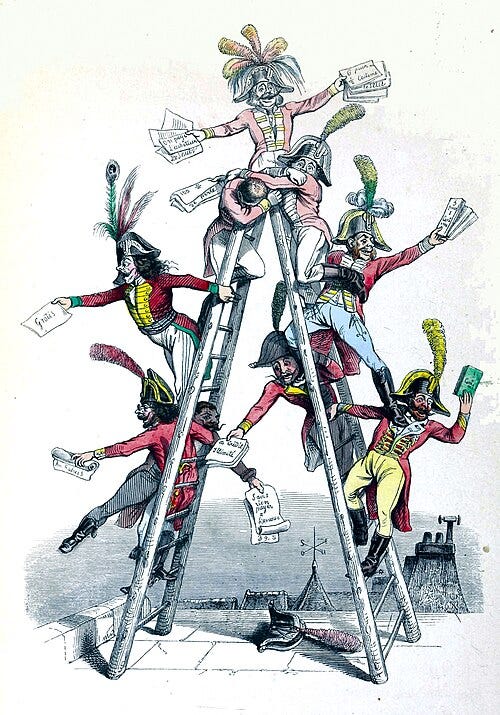
The post’s image is J. J. Grandville, La Concurrence, from Un autre monde (1844). Public domain, via Wikimedia Commons.
I think it's worth noting that religion is a technology of ego-death or ego suppression that creates communal benefits by attacking selfishness directly. This is achieved not instantaneous but through decades of habit formation and indoctrination (I use that term neutrally). You only get alturistic communities through extended deprogramming, and even then the profit motive is present only relegated. This is why many traditions have an idea of a failed human disposition to do his.